The Two Confronted Horses — The emotions that stop fighting
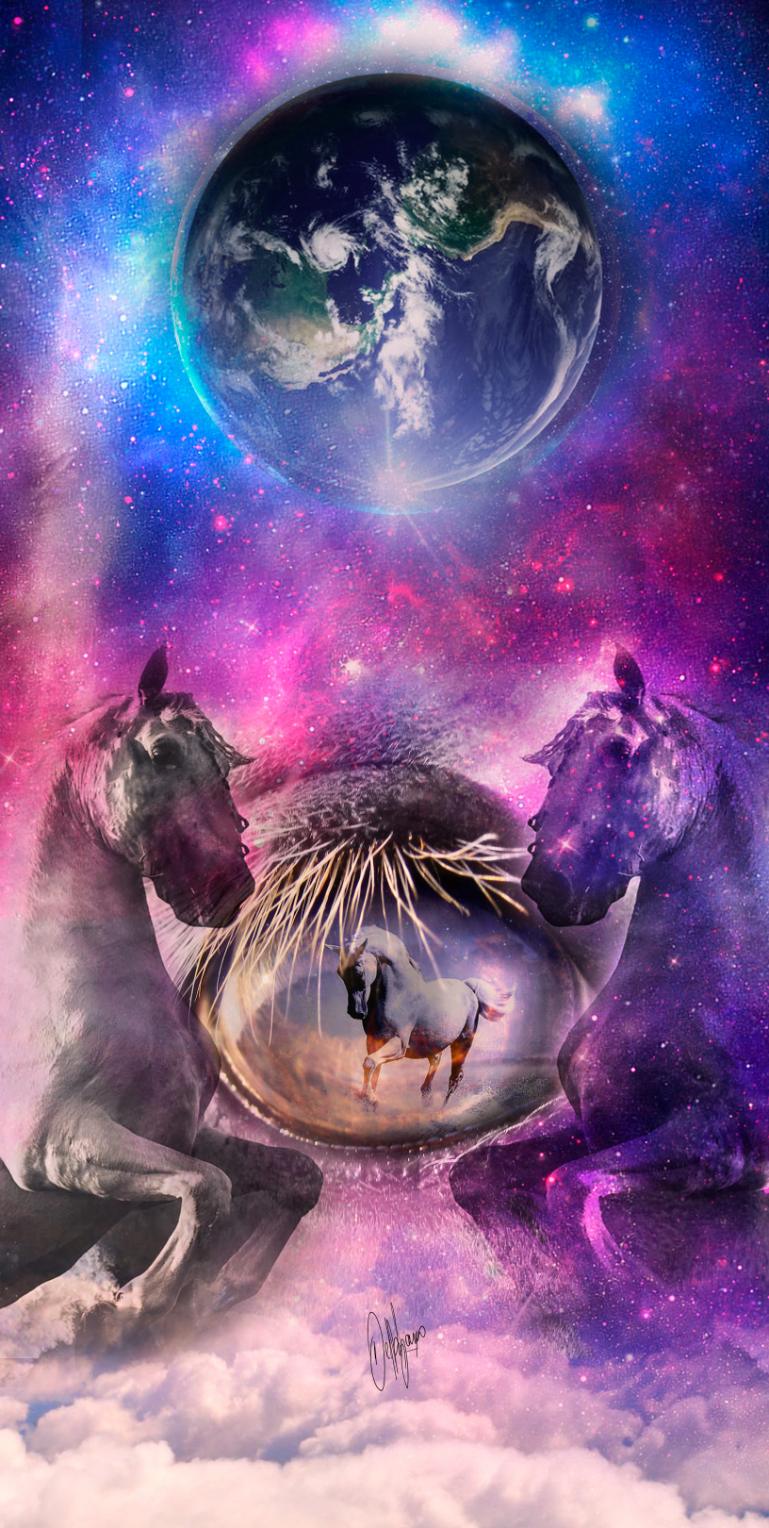
What is seen: Two large horses at the sides of the image, one lighter and one darker, facing each other, their bodies curving toward the center. Ethereal, made of cosmos—stars, nebulae, space. They are your opposing emotions. Impulse and doubt. Anger and tenderness. What pushes you forward and what holds you back. They are not fighting—they face each other without aggression, like two forces that finally recognize one another. A horse is not a meek animal. It is brute force, instinct, power. For two horses to stand like this, face to face without attacking, is not weakness. It is the hardest thing strength can do: contain itself without putting itself out.
The Eye of the Horse — What opens in the center
What is seen: Between the two horses, an oval shape with thick, hard eyelashes—the eyelashes typical of a horse, rigid like bristles. Inside the pupil, a third horse. It is an eye. Not a human eye—a horse's eye, with its coarse lashes, its elongated shape, its lateral gaze. A horse's eye sees almost 360 degrees: it sees what is in front and what is at the sides at the same time. When your confronting emotions grow still, a perception opens that sees everything without needing to turn its head. It is not analytical vision—it is total vision. What some traditions call the third eye: the perception that appears when the dual is integrated.
The Third Horse — The essence that appears
What is seen: Inside the pupil of the eye, a white and brown horse in motion within a more earthly environment. It is the third one. It is neither larger nor more luminous than the other two—it is more real. While the outer horses are cosmic, ethereal, made of stars, this one has earth colors, feet on the ground, a concrete body. It is your essence when emotions stop blocking the view. It is not an ideal—it is what you are when the noise stops. It is born not from the negation of emotions, but from their encounter. The two outer horses do not disappear for the third to appear. They remain there. But now, instead of blocking your gaze, they frame it.
The Planet Earth — What observes from above
What is seen: The entire Earth in the upper part of the image, with visible continents, clouds, and oceans. A point of light sits between the Earth and the scene. What happens between the horses is not an intimate event that only matters inside you. It has scale. The Earth is above, not below—it is not something you stand on, but something looking at you. When your forces integrate and the eye opens, what you see is not just your interior: it is your place in something larger.
The Nebula Sky — The space where this occurs
What is seen: A cosmic background in purples, pinks, magentas, and blues. Scattered stars. It is not a night sky—it is a living space, filled with color. It is not empty. It is a charged space, dense with color and movement. Emotions do not grow still in a neutral, sterile place—they grow still in the midst of everything that keeps happening. The peace that allows you to see does not need absolute silence. It needs you to stop fighting inside while everything outside keeps moving.