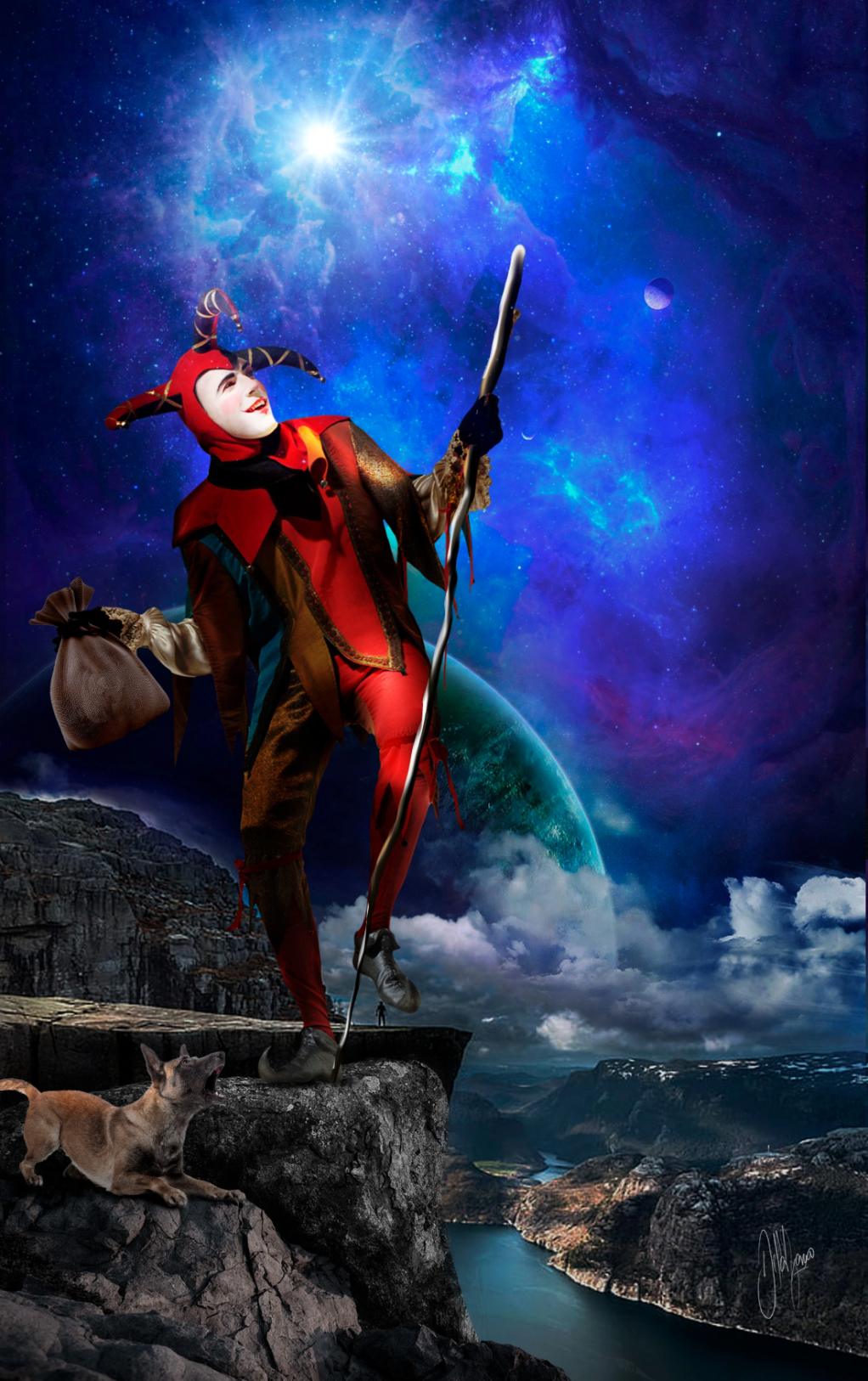
The composition is vertical and dramatic. At the center: a fool wearing a red and brown costume, a pointed hat with bells, and a smiling white mask. He stands at the edge of a rocky cliff, one foot almost in the air. In one hand he holds a small cloth bag, in the other a long staff. He looks upward toward a bright star within a purple-blue cosmic sky. At his feet, a dog lies quietly upon the rock. Below the cliff: a landscape of fjords, dark mountains, a river winding through the bottom of the canyon, clouds among the peaks. Behind him: a large blue-green planet partially visible. Far away, upon another rock formation, a tiny human figure can be seen.
The Jester — The one who laughs at what no longer matters
What is seen: A man in a red and brown-gold jester suit, a pointed hat with bells, and a smiling white mask. He looks upward with his body leaning toward the void. The jester is the one who can tell the truth because no one takes him seriously. He is the only one who enters the throne room and laughs at the king without being punished. That is his power: he has no image to protect, no title to lose, no position to guard. The red and brown suit is neither elegant nor ragged—it is what someone puts on when they stop dressing for others. The mask smiles not out of naivety, but because it has already seen everything and chooses laughter.
The Edge of the Cliff — The step that cannot be rehearsed
What is seen: The jester standing with one foot on the rock and the other almost in the air. The cliff drops down into a deep canyon with a river far, far below. This is the fool's step. It is not a calculated leap—it is just another step, like all the others, except that underneath there is no floor. Everything built up to this point—discipline, discernment, surrender, flight—arrives at this spot where the final question is not "am I ready?" but "do I trust?". The edge is not a punishment or a test. It is the natural place where the known path ends.
The Small Pouch — The only thing carried
What is seen: A small brown cloth pouch that the jester holds in one hand. It is not luggage. It is what remains when you let go of everything that was not essential. Your distilled lessons, your compressed experience, what you learned reduced to what fits in one hand. It does not weigh anything. It is not opened to be shown. It is simply carried, and that is enough. The one who crosses the edge does not need to prove what they know. They wear it.
The Staff — What sustains you but does not bind you
What is seen: A long, slender staff that the jester holds in his other hand, resting on the rock. It is not a weapon or a scepter. It is a point of support—something practical, concrete, that helps you walk through uneven terrain. In this context, it is the last thing touching the rock before the foot lifts. It is your axis, your center, what kept you vertical throughout the journey. But the staff can be let go of too.
The Resting Dog — The instinct that now sleeps
What is seen: A small dog, lying down on the rock to the left of the jester. It does not bark, it does not pull, it does not warn. It is lying down, still. In traditional tarot, the fool's dog barks: it warns of danger, pulls at the clothes, tries to stop him. Not here. The dog is lying down. It no longer warns because it is no longer necessary. The survival instinct fulfilled its function throughout the whole path and now it rests. Not because it is indifferent—because it trusts. When your own body stops screaming danger in front of the void, it is because something in you knows that what comes next is not a fall.
The Star — What the fool looks at
What is seen: A point of intense, white-blue light in the cosmic sky, directly above the jester. The jester does not look at the void. He does not look at the landscape. He does not look at the dog. He looks upward, toward a star. That defines everything: the step is taken while looking at what pulls you, not at what you leave behind. It is not that the void doesn't exist—it is just that it is not where the eyes are going. Freedom is not achieved by looking at what you lose. It is achieved by looking at what calls you.
The Tiny Figure on the Distant Rock — The one who hasn't arrived yet
What is seen: A very small human silhouette, standing on another rock formation in the distance, on the right side of the image. It is there. Far away, small, barely visible. It is someone else on the path—or it is you at another moment, watching from a distance the fool who is about to take the step. It adds scale: the jester is not a giant. He is just a guy at the edge of a rock in an enormous landscape. And he takes the step anyway.
The Planet and the Cosmos — What follows past the edge
What is seen: A large blue-green planet, partially visible behind the jester. Cosmic sky with purple and blue nebulae. What lies past the step is not emptiness. It is cosmos. It is a planet. It is space with form and color. The edge of the cliff seems like the end, but behind the jester there is a whole world. What ends is the known path. What begins cannot be seen from here—but it is there.