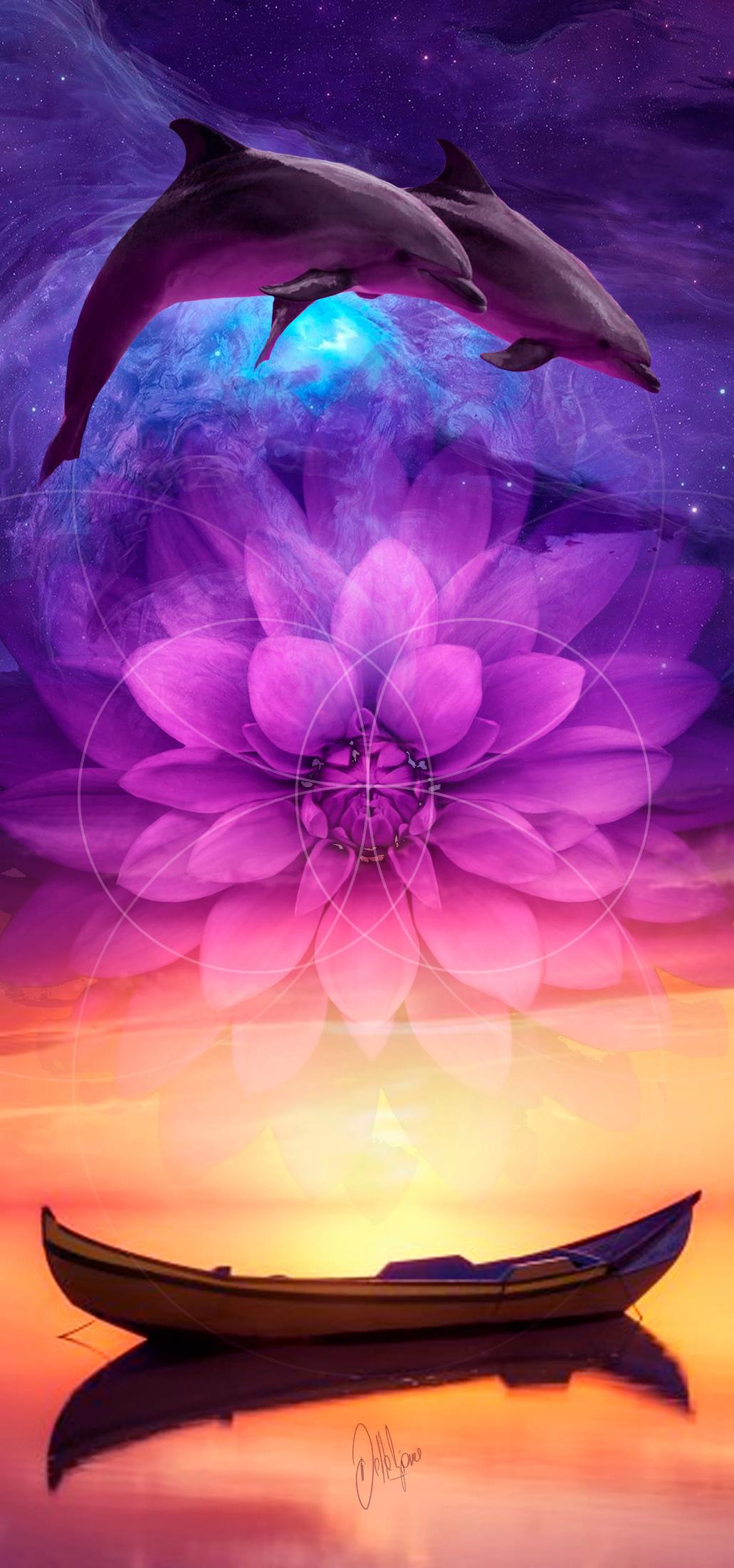
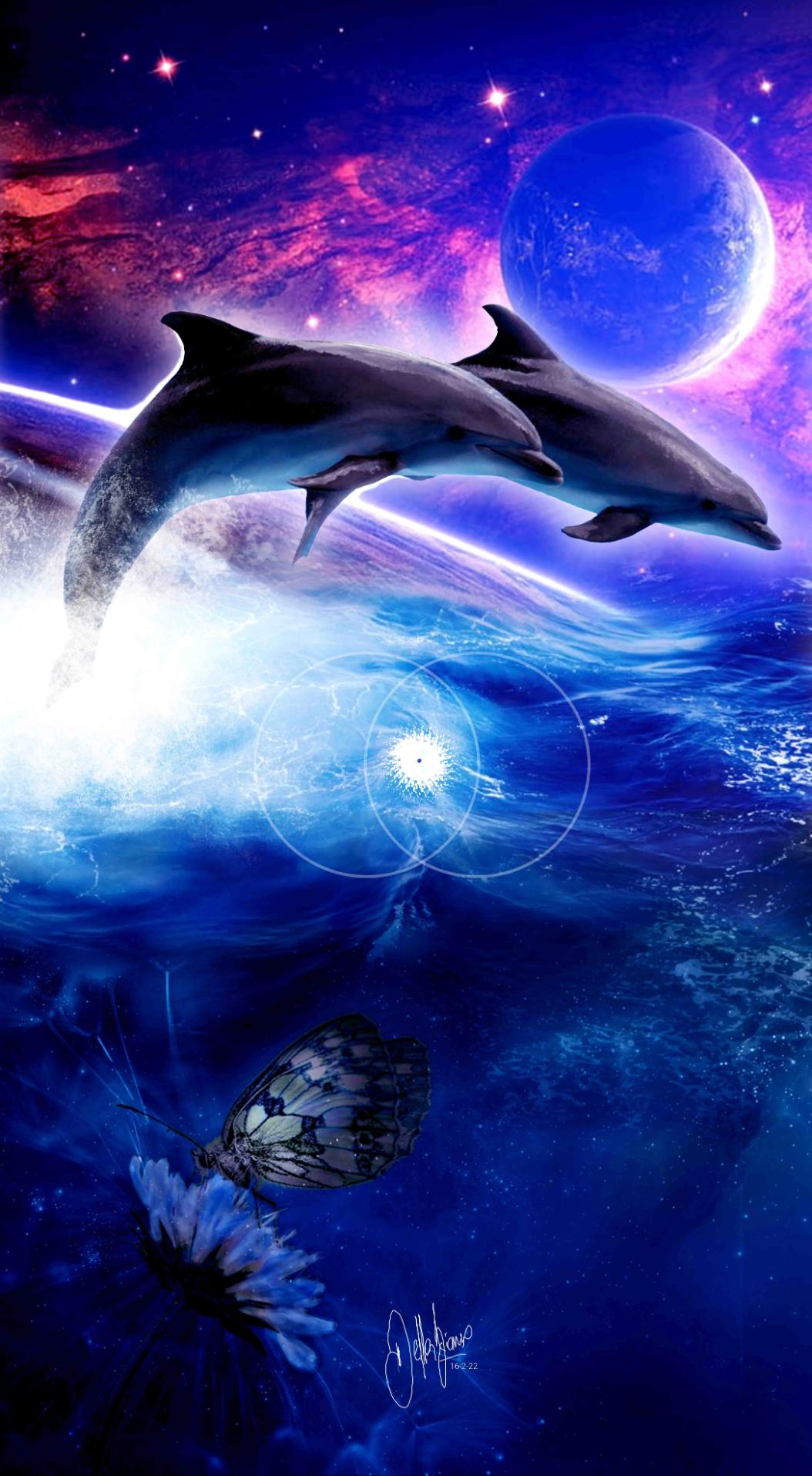
The composition is organized in three bands of color. Below: calm water in golden and orange sunset tones, with an empty wooden boat reflected on the surface. In the center: a large purple and pink lotus flower, fully open, with subtle geometry of circles behind it. Above: a cosmic purple sky with stars, and two dolphins leaping over a sphere of light blue light. The progression flows from bottom to top: the simplest element (the boat) rests at the bottom, the most vibrant (the flower) in the middle, and the freest (the dolphins) at the peak. Yet, the element that organizes the whole is the sunset—that golden horizon where the day surrenders itself.
The Empty Boat — That which floats without needing a captain
What is seen: A small wooden canoe, without oars, without a sail, and with no one inside, floating on calm water. Its reflection is perfect on the golden surface. It is empty. It did not shipwreck, it was not abandoned—it simply has no crew. Yet it floats, perfectly balanced, reflected in the water as if the water itself were holding it up. This is the most precise image of humility: someone does not need to control for something to be sustained. The boat does not need you to direct it. It needs you to trust that the water carries it. Letting go of the oar is not surrendering to chaos—it is recognizing that there is something sustaining you without you having to force it.
The Golden Sunset — The moment where the light surrenders
What is seen: A band of warm, golden, and orange light at the bottom of the image. The horizon where the sun goes down. The sunset is not an end—it is a surrender. The day does not turn off violently. It yields. It becomes golden right before leaving, as if the best light appeared at the exact moment of letting go. This is what happens when you stop holding everything up with force: what comes out of you at that moment is not darkness. It is the warmest light you have.
The Lotus Flower — That which opens without effort
What is seen: A large, purple and pink lotus flower, completely open, occupying the center of the image. Broad, symmetrical, luminous petals. The lotus grows in the mud and blooms on the surface. It does not need clean soil to be what it is. This flower is not struggling to open—it has already opened. It is there, whole, without tension. In a card about humility, this says something: it is not about exerting effort to bloom. It is about ceasing to resist the opening. The flower does not decide to open. It opens because it is time.
The Dolphins — What leaps when you let go
What is seen: Two gray dolphins leaping together in the upper part, over a sphere of light-blue light, against the starry purple sky. They leap with joy. They do not leap to escape or to prove anything. They leap because that is what they do when the water allows them to. In an image where the boat is empty and the flower opened on its own, the dolphins are what appears when there is nothing left to hold up: pure movement, weightless, with no fixed destination. The joy that comes after letting go is not loud. It is light.
The Subtle Geometry — The order that does not impose itself
What is seen: Soft concentric circles behind and around the lotus flower, barely visible, like a delicate structure overlaid onto the image. It is there, but it does not dominate. It does not scream "order"—it suggests it. The geometry behind the flower says that there is structure, form, and proportion, but they do not need to be named or controlled to function. Real order does not impose itself. It sustains in silence.
The Starry Sky — What follows when the day surrenders
What is seen: Dark purple sky with scattered stars at the top. After the sunset comes the night. And the night is not empty—it has stars. What come after letting go of control is not a black hole. It is a space with its own lights, dimmer, more distant, but real. You do not need the sun to see. You need eyes that get used to the dark.