Back to gallery
The Soul - The Crossing
Card N°9 · Spirit Level

The Soul

The Crossing

There are journeys that begin when someone who was sailing with you is no longer there. You did not prepare for the helm. You did not ask to take charge. But the ship keeps moving, the sea does not wait, and the only option that does not exist is to stay where you are. The crossing of the soul does not begin with an act of bravery. It begins with a loss that leaves you alone before the open expanse.

The Crossing appears when something that sustained you is gone—a person, a certainty, a version of yourself—and the sea remains open. This is not the card of the chosen adventure. It is the card of what happens when there is no other option left but to take the helm and keep sailing.

Every genuine crossing begins with a loss, not a decision. The solar hero chooses to depart; the soul does not choose—it responds to what has already occurred. This card embodies that turning point where grief ceases to be paralysis and becomes movement, not because the pain has ended, but because the ship does not stop.

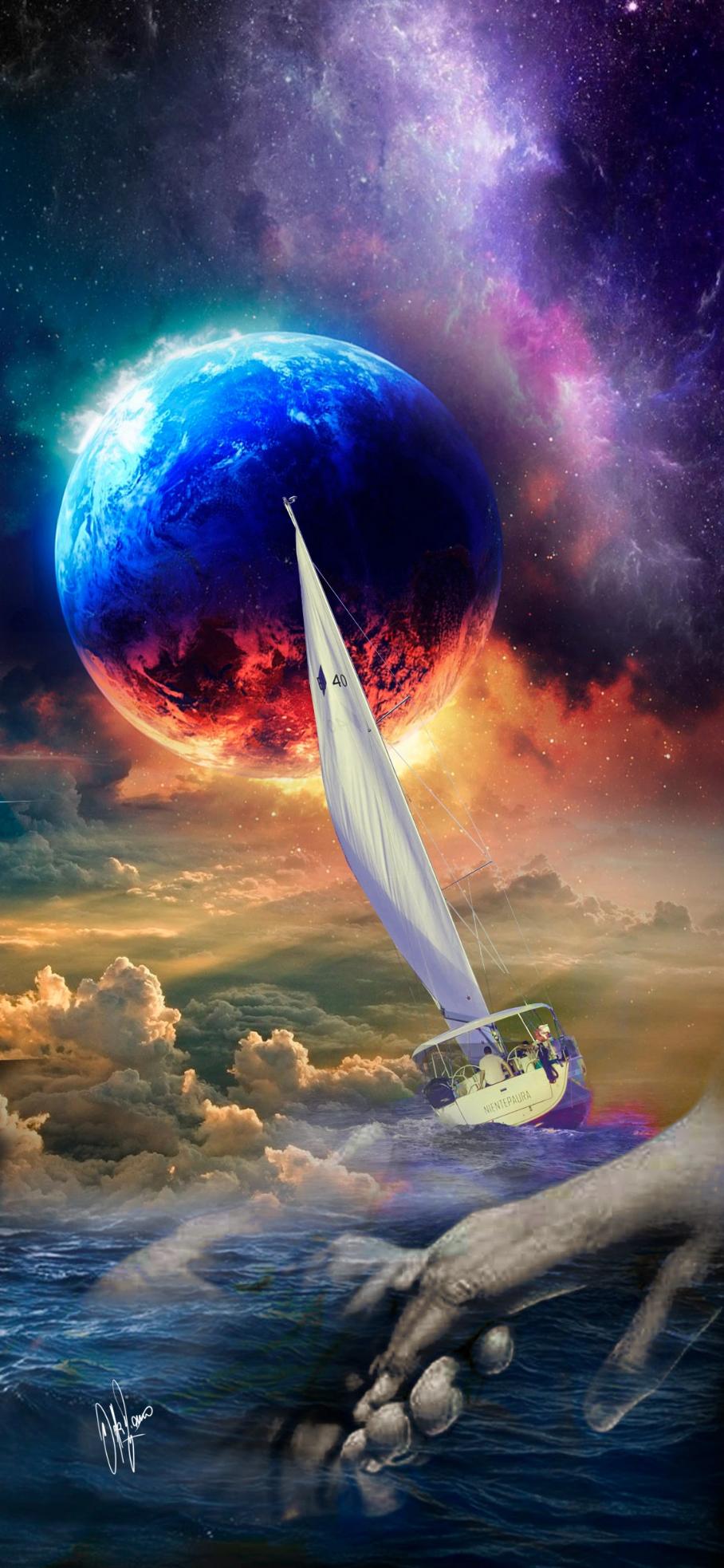
What gives density to this card is the coexistence of the cosmic and the stripped-bare. The entire scene burns with color—planets, fire, deep skies—but the truest thing is in gray: two hands reaching for each other without adornment, without scale, without spectacularity. It is a deliberate inversion of hierarchy: the grandiose is not the most real. The most real is the naked human gesture, the contact that is attempted or lost. Jung spoke of the nigredo as the phase where everything incidental is burned away, leaving only the essential. Those hands are the nigredo made image—what survives when color, shine, and narrative fade out.

The name on the hull—Niente Paura, No Fear—is not a starting point, but a destination. One does not sail without fear from the beginning; one reaches that condition after having touched bottom and returned. The number 40 on the sail confirms it: forty days, forty years, forty nights—in all traditions, the number of a transit that cannot be shortened. The crossing of the soul has no express version. It is walked in its entirety.

And what waits on the horizon is not a finished destination, but a world in full transformation—half fire, half cold, something that has not yet finished becoming what it will be. That is the hardest honesty of this card: it does not promise arrival. It promises that if you keep sailing, what you find ahead will be just as incomplete and alive as you are. The crossing does not end in port. It ends when you stop needing one.

The Hands in Grayscale — The Most Human Element in the Most Cosmic Image

What is seen: Two hands reaching for each other through the water. They are rendered in gray, without color, while the rest of the image burns in blues, reds, and golds.

This is the most powerful aspect of the card. The hands are the only element stripped of all effects—no color, no glitter, no cosmos. Pure humanity. They could be the hand of someone leaving and the hand of someone staying. They could be you searching for something in the depths of your own unconscious. They could be the contact between who you are and who you used to be. What they are not is abstract: they are flesh, bone, and gesture. The most real moment of the entire image is at its most naked point.

The Sailboat "Niente Paura" — "No Fear" Is Not the Departure, It Is the Arrival

What is seen: A white sailboat navigating between the water and the clouds, with sails unfurled. On the sail, the number 40. On the hull, the name "Niente Paura".

"No Fear" is not what you feel when you set sail. It is what remains after having touched bottom and returned. The ship's name is not a starting mantra—it is a declaration of someone who has already passed through the worst and keeps sailing. The white sails are open: there is wind, there is movement, there is direction. But the ship navigates in that zone where the sea and the clouds blur together—where there is no clear boundary between what you know and what you do not. The crossing is not going from one port to another. It is learning to navigate when the map has ceased to serve.

The Number 40 — The Universal Passage

What is seen: The number 40 marked on the sail of the ship.

40 days of the flood. 40 years in the desert. 40 days of temptation. 40 days of Lent. In almost all traditions, the number 40 marks a period of testing, transit, and transformation—a time that can neither be shortened nor negotiated. It is not a number of achievement: it is a number of process. The crossing of the soul has no shortcuts. It is transited entirely, day by day, until what had to change, changes.

The Dual Planet — The World That Has Not Yet Finished Transforming

What is seen: A massive planet in the sky, with the upper half blue and the lower half a fiery red. Warm clouds surround it.

It is not a completely "burning planet"—it is a planet in transition. The red part burns, transforms, and consumes the old. The blue part is still intact, cold, and unprocessed. The reading is direct: not everything transforms at the same time. There are parts of you that have already passed through the fire and parts that have not yet. The crossing is not an event: it is an uneven process where some areas have already changed and others still resist.

The Merged Sea and Clouds — The Dissolution of the Known

What is seen: The sailboat navigates in a space where water and clouds blend. There is no clear horizon.

When what sustained you disappears, the boundaries between things dissolve. What was solid becomes liquid; what was clear becomes cloudy. This is not chaos—it is the natural state of a profound transit. The ship does not need a horizon to move. It needs wind.

The Palette — Fire Above, Depth Below, Gray in the Human

What is seen: Vivid cosmic colors (reds, blues, golds, purples) throughout the scene, except for the hands, which are gray.

The contrast says something that the text must not obscure: the most grandiose parts of the image (planets, cosmos, clouds of fire) are in color. The truest part (two hands seeking each other) is in gray. Sometimes the deepest experience is not the most spectacular. Sometimes it is the simplest.

Guided meditation
Coming soon

Guided Meditation

Will be available soon.

Card Affirmation

"What sustained me is no longer here. The helm is now mine."

The Unwritten Letter

Sit in a quiet place. Think of someone or something that is no longer there—a person, a version of yourself, a certainty that left. Someone or something that was sailing with you and ceased to be.

Take a piece of paper. Begin to write what you would say to them if you could. No censorship, no structure, without caring about the form. Whatever comes out.

When you finish, do not reread it. Fold it. Keep it or destroy it—whatever you feel is appropriate. The act is not the letter: it is the gesture of saying what you could not say.

The hands in the image seek each other in the water. Your hand has just reached for what it needed to touch.

  • What have I lost that I have not yet finished letting go of?
  • Who or what was at the helm of my life before I had to take charge?
  • What did I find at the bottom when I touched the deepest part of my shadow?
  • Am I sailing or am I adrift? What is the difference for me?
  • What does "no fear" mean after having experienced the worst fear?
  • If I could stretch my hand toward someone through the water, who would it be?

No one navigates their own waters without first touching bottom.

That is what this card demands: to go down. To meet the shadow that lives in the depths—the pain you did not name, the loss you did not close, the part of yourself you preferred not to look at. And to stay there for as long as it takes, without shortcuts, without borrowed consolation, without the 40 on the sail rushing you.

But when you rise—and you do rise—something has changed forever. What you held with fear, you let go. What sustained you from the outside, you replace with something born from within. And the helm that was once in the hands of others—of what they taught you, of what they expected of you, of whoever is no longer here—is now in yours.

"Niente Paura" is not written on the hull before setting sail. It is written after having survived the sea you believed was going to swallow you.

Previous Next