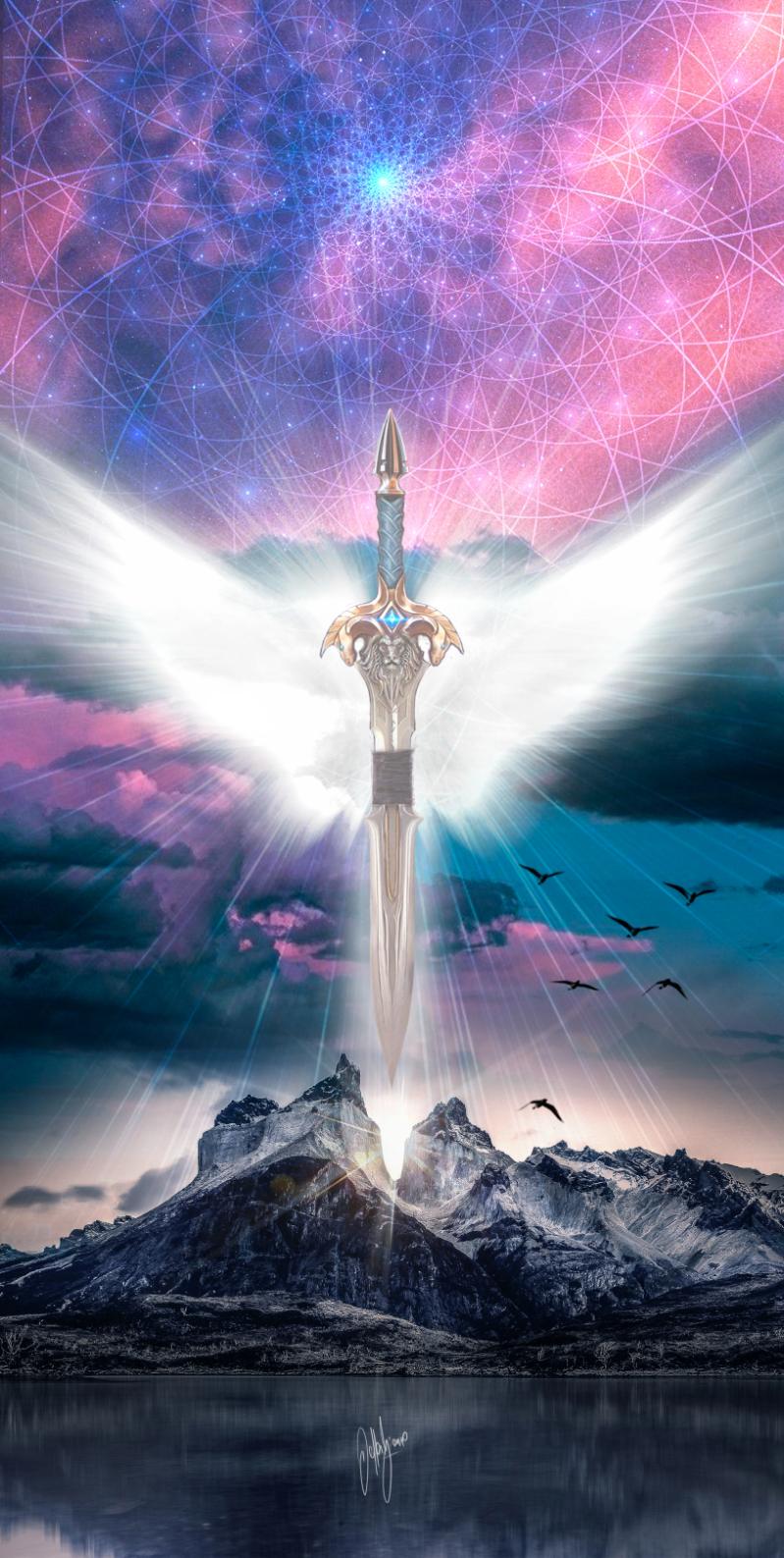
The Sword — The Logos That Discerns
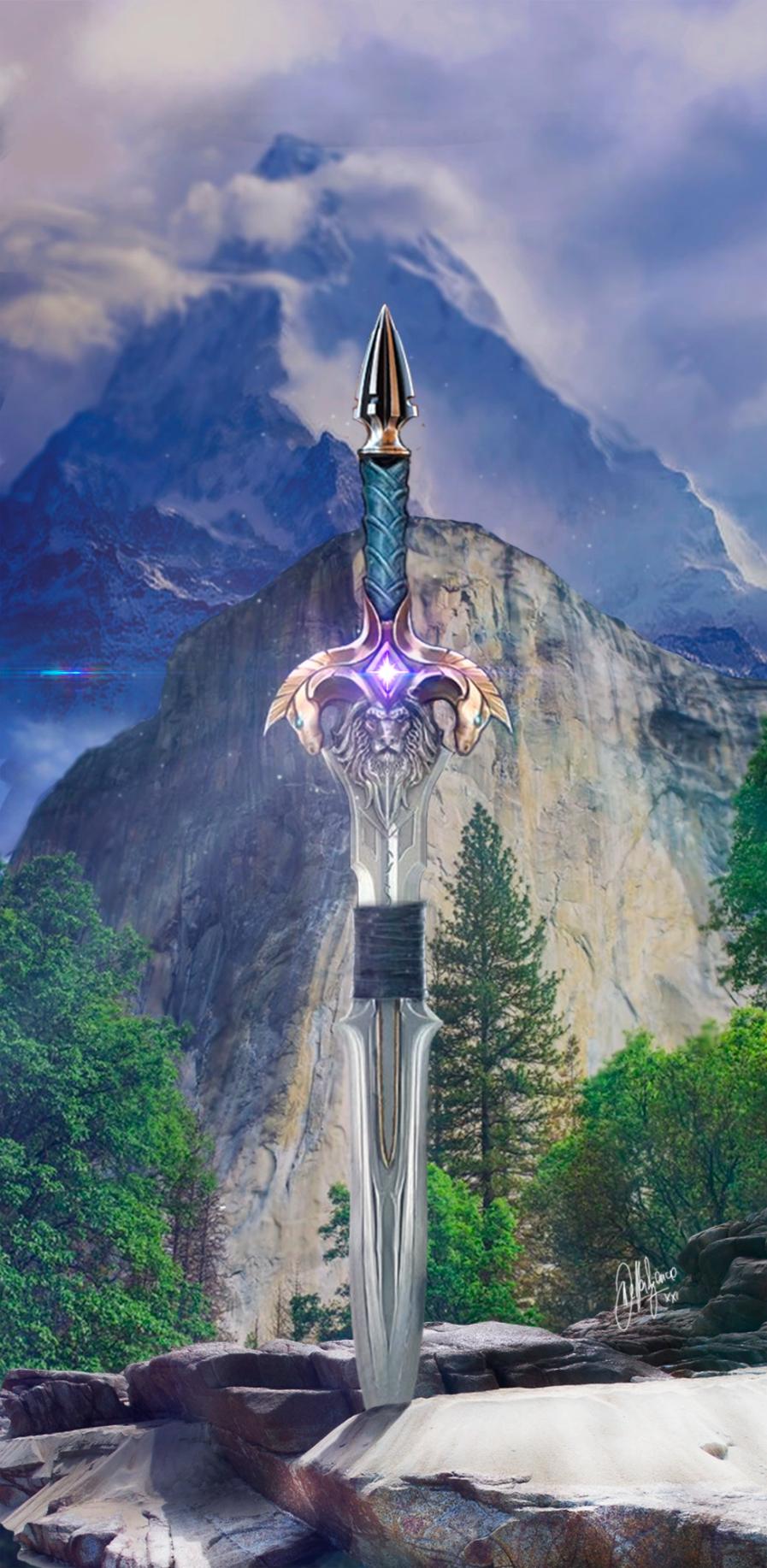
What is seen: A double-edged silver sword, with a clean and well-proportioned blade. It is not a crude weapon—it is forged with precision; every line has an intention.
In the symbolic tradition, the sword does not represent violence but the capacity to cut—to discern, to separate the true from the false, the essential from the incidental. In Jungian psychology, it is a symbol of the Logos: the function of consciousness that names, distinguishes, and orders. Wielding the sword means accepting the responsibility of seeing clearly, even when what you see is uncomfortable. The double edge reminds us that this capacity cuts both ways—it can liberate, but it can also wound if used without maturity.
The Stone — The Veil That Sustains and Reveals
What is seen: The blade of the sword penetrates a solid rock in the foreground. The stone is neither broken nor fractured—it holds the sword firmly.
The stone is the "veil" of the title. It does not hide power—it cradles it. It is the raw material, the necessary resistance that prevents power from falling into hands that are not ready. In alchemy, the stone is the prima materia: the dense, the untransformed, that which needs to be worked upon before surrendering its secret. But here, the stone does not need to be destroyed to release the sword—it needs to be understood. The act of extracting it is not brute force; it is a mutual recognition between the hand and the steel.
The Guardian Face — The Threshold of Worthiness
What is seen: On the guard of the sword, a carved face—features of a lion or a mythical beast, with a severe expression. In the center, a violet gem emits its own light.
This is the most unsettling element of the image. It is not an ornament—it is a custodian. The face looks directly at whoever approaches. It functions as a mirror of intention: what do you want this power for? To serve or to dominate? The violet gem at its center suggests a perception that goes beyond the visible—the guardian does not evaluate the strength of your arm; it evaluates the integrity of your purpose. Violet is the color associated with transmutation and inner vision: only one who has done inner work can hold the guardian’s gaze without stepping back.
The Mountain — The Scale of Commitment
What is seen: A massive mountain behind the sword, with vertical rock walls and snow or clouds at the summit, imposing in its verticality.
The mountain is not the destination—it is the context. It gives the act of wielding the sword its true dimension: this is not a game. Claiming your power implies accepting a landscape of that scale—real challenges, real heights, real falls. The mountain is also patience made matter: it was there before you, and it will remain after. The power worth claiming is that which is measured against something permanent, not something fragile.
The Trees — Life That Does Not Wait for the Hero
What is seen: Green conifers in the mid-ground, between the foreground rock and the mountain. Alive, vertical, without drama.
The trees are the most sober reminder in the image: while the sword waits and the mountain imposes, life goes on. They grow without needing to claim anything. They do not seek power—they simply are. Their presence tells the observer that power is not the whole story. There is a way of being in the world that requires no sword, no stone, and no proof. The trees wield nothing, yet they sustain the entire landscape.
The Cloudy Sky — What Is Not Yet Seen
What is seen: Dense clouds cover the summit of the mountain and dominate the sky. There are no stars, no clear sun—there is a diffuse light that arrives without a visible source.
The clouds fulfill the function of the veil on the higher plane. The summit of the mountain—what you might become if you wield the sword with integrity—is unseen. You are not shown the result before you act. That is honesty: true power is claimed without guarantee of what comes next. Clarity is not a precondition; it is a consequence of the act.