Back to gallery
The Internal Verb - The Edge of the Logos
Card N°6 · Spirit Level

The Internal Verb

The Edge of the Logos

Truth does not impose itself: it becomes inevitable when it is born from the center. It does not arrive with shouts. It arrives with an edge. With a precision that cuts without violence. There are moments when speaking is not about arguing or convincing: it is about ceasing to betray yourself. When what you think, feel, and say point in the same direction, your voice stops trembling. It becomes verb. It becomes sword. It becomes light.

The Internal Verb appears when there is a distance between what you know to be true and what you are willing to say out loud. It is not a card about speaking more—it is about ceasing to betray your center every time you open your mouth. Coherence between what you think, feel, and say is not an ideal: it is an edge.

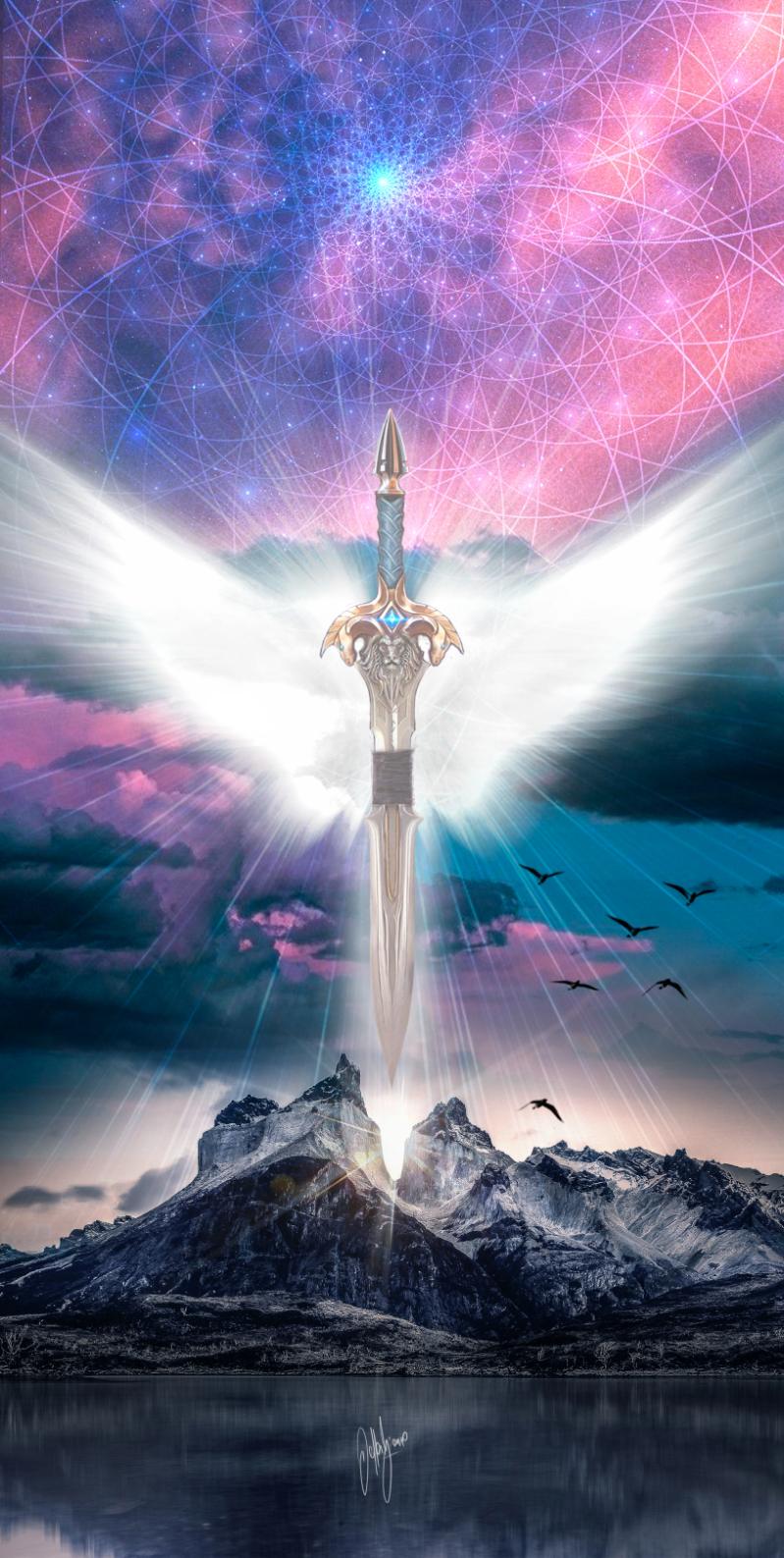
A sword that floats without hands, without support, without a stone to be driven into, says something before any reading begins: internal truth does not need to be held up. It sustains itself by its own coherence. It does not depend on who says it or the context in which it is said—it depends on its alignment with what is.

What transforms this sword into something other than a cutting instrument are the wings. The edge points upward, not downward. It is not discernment penetrating matter—it is a word that ascends. The truth of this card does not operate by crushing: it elevates. When what you say and what you are coincide, the word stops being a tool and becomes flight. The wings also protect: truth spoken from the center needs no aggression to sustain itself, because coherence is its own defense.

The guardian carved into the guard functions as a filter of intention—a threshold that the word must cross before coming out. Do you speak to clarify or to dominate? To reveal or to wound? The gem at the center of the face is a perception that cannot be deceived: the eye that sees the motivation before the mouth opens. The edge exists, but not everything you could say deserves to use it.

That the light of the scene does not descend from above but is born from the point where the sword and wings meet is the most precise declaration of the card. Clarity does not come to you from the outside. It comes out of you when what you say and what you are stop being separate things. And the geometry of the Logos structuring the sky above confirms that your true word is not just a personal opinion—it is your participation in an order that exceeds you. You do not invent the truth when you speak from the center: you align yourself with something that was already there.

The Suspended Sword — The Truth That Stands Alone

What is seen: A vertical sword floating in the air, without support, without hands wielding it. The blade points upward. It is ornate yet precise—every line has an intention.

The sword is not being used by anyone. It does not belong to an ego or an agenda. It floats because its authority does not depend on who holds it—it depends on its alignment. In symbolic tradition, the sword is discernment: the capacity to separate the true from the false, the essential from the incidental. That it is suspended in the air says that this capacity has already been released—it is not waiting to be claimed; it is already operating.

The Guardian Face — That Which Guards the Word

What is seen: On the guard of the sword, a carved face—features of a lion or mythical beast, with a severe expression. A blue-turquoise gem shines in its center like an open eye.

The guardian does not let just any word pass. It functions as a filter of intention: do you speak to clarify or to wound? To reveal or to dominate? The gem in the center of the face suggests a perception that cannot be deceived—the eye that sees the motivation behind the word before the word comes out. The sword has an edge, but the guardian decides if that edge is used with integrity.

The White Wings — Truth That Elevates Instead of Crushing

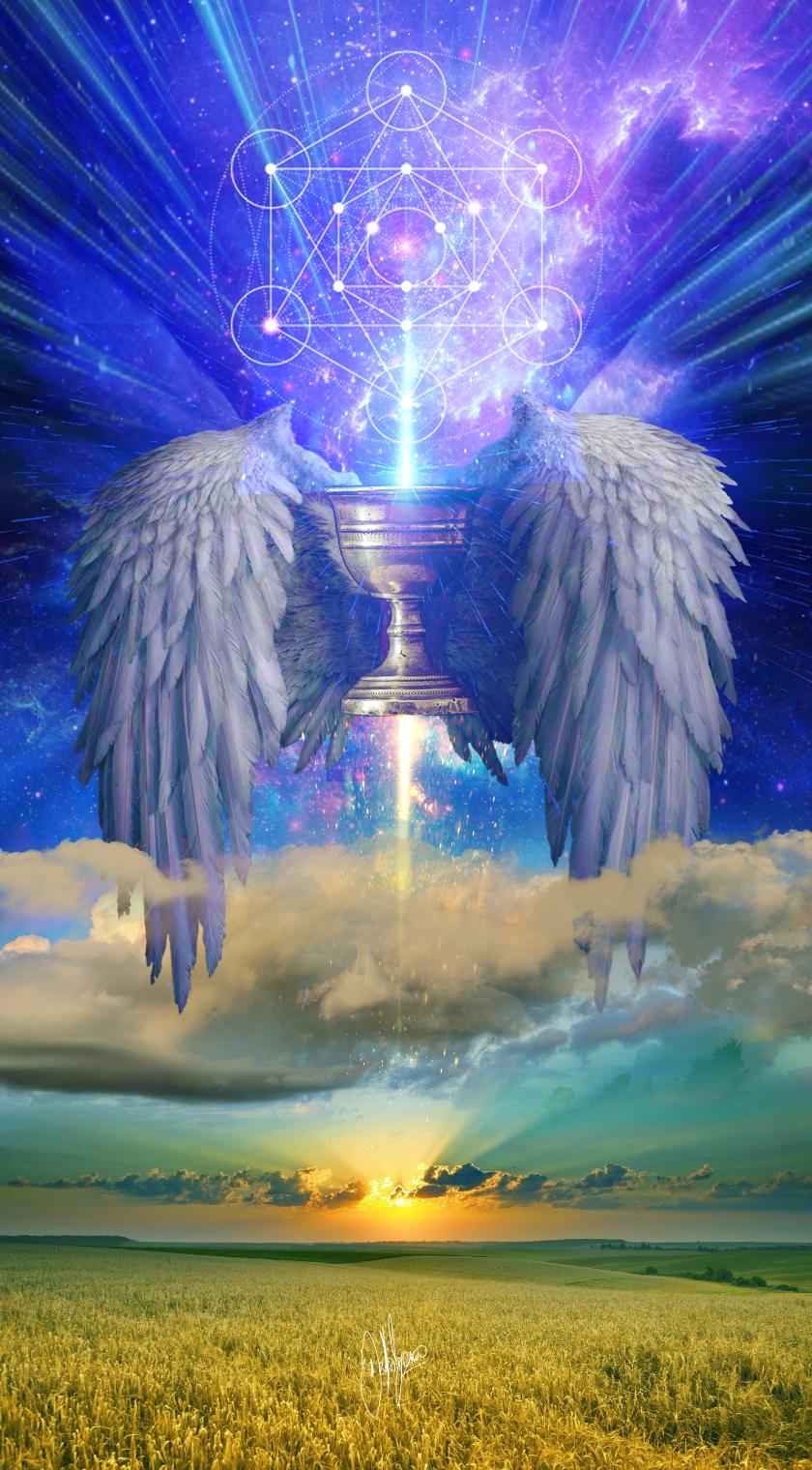
What is seen: Two large, luminous white wings extending from the guard of the sword to the sides. They radiate their own light.

The wings transform the sword from an instrument of cutting to an instrument of elevation. The truth this card proposes is not the kind that crushes the other with "I am right." It is the kind that lifts you up when you hold it with cleanliness. The wings also protect: when your word is born from the center, it does not need to attack to sustain itself. It defends itself because it is coherent.

Sacred Geometry — The Visible Logos

What is seen: In the sky, above the clouds, a geometric pattern of interconnected lines reminiscent of the Flower of Life. A bright blue point of light in the upper center functions as a focus or source.

"Logos" in Greek is not just "word"—it is the principle that orders reality. Sacred geometry is the visual representation of that order: patterns that repeat across all scales, from molecular structure to the shape of galaxies. That the sword points toward it says something important: your internal verb is not just "your truth"—it is your participation in an order that exceeds you. When you speak from the center, you invent nothing: you align yourself with something that already existed.

The Mountain — Where Truth Is Tested

What is seen: A snowy mountain range below the sword, with sharp peaks. The sword does not touch them—it floats above.

The mountain is the concrete world. Truth that does not touch the ground is merely parlor philosophy. But the sword is not driven into the summit either—it is above it, indicating that the true word comes from a place higher than circumstance. The mountain is where what you say is tested: in difficulty, at the edge, in the real decision. The snowy peaks suggest cold clarity—truth is not always warm.

The Birds — What Is Released When You Speak with Truth

What is seen: Several birds flying in silhouette against the sky, to the right and below the sword.

The birds do not sustain the sword nor depend on it. They fly free in the same space. They are what happens when the internal verb awakens: perspective, lightness, the capacity to see from above. When you stop using the word to manipulate or defend yourself, something is released.

The Water — The Mirror That Does Not Lie

What is seen: A dark, calm body of water at the base of the composition, reflecting the scene.

Water reflects. What you say is seen. Coherence, sooner or later, becomes visible to others—but first, it becomes visible to you. The water mirror is the simplest test: does what I say look like what I am? If there is distortion in the reflection, it is not the water's problem.

Guided meditation
Coming soon

Guided Meditation

Will be available soon.

Card Affirmation

"What I think, what I feel, and what I say point in the same direction. My word has an edge because it has a center."

Sharpening the Verb

Sit in silence. Breathe seven times, slowly.

Write a single phrase that begins with: "My truth today is..." Do not overthink it—write the first thing that appears.

Read it in a low voice. Then read it again, but this time paying attention to whether it comes out with tension or with calm. Are you saying it from reaction or from the center? Does it sound like defense or like clarity?

Adjust it until it feels true—not aggressive, not diplomatic, but true. When the phrase no longer generates discomfort or pride, it is sharpened.

Now write a second phrase: "What I need to stop saying is..." Same rule. Sharpen it until it is precise.

Keep the two phrases. Do not make them public. They are your sword for today.

  • What truth am I avoiding saying—not out of malice, but out of fear of what changes if I say it?
  • Where do I speak to please and end up losing myself?
  • How does it feel in my body when I say something aligned vs. when I say something to look good?
  • What part of me wants to use the word as a weapon, and what part wants to use it as light?
  • What illusion about myself do I need to cut away today?
  • If my voice were a winged sword, what would it protect and what would it release?

The Internal Verb does not ask you to confront the world. It asks you for something more intimate: to stop silencing yourself.

The sword floats because it needs no one to hold it. The wings give it direction without taking away its edge. And the geometry of the sky reminds you that your word, when it is true, is not just yours—it participates in a larger order.

Previous Next