The Tree in the Rock — What Grows Without Ideal Conditions
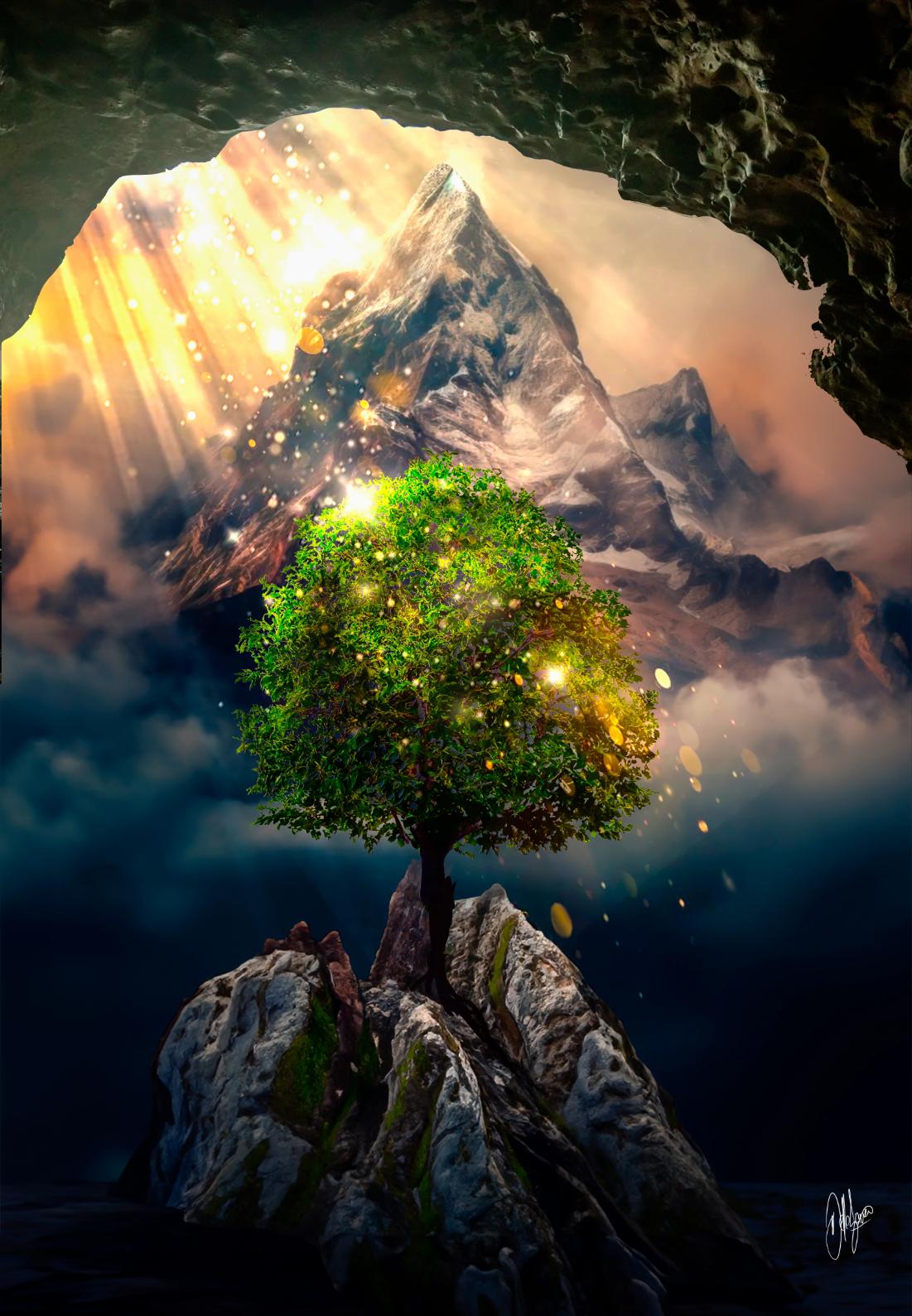
What is seen: A green, leafy, alive tree growing from a rocky formation with no visible soil. Golden particles—fruits, seeds, or sparks of light—shine among its leaves.
The tree does not have what it "should" have to live. There is no fertile soil, no meadow, no gentle conditions. And yet, it is more alive than any tree in a manicured garden. The roots found the crack in the stone and broke through. That is what it means to root: not waiting for the perfect place, but transforming the place you have into the place where you grow. The golden fruits among the leaves show that this tree does not merely survive—it thrives. That which roots itself in difficulty, when it is genuine, bears fruit.
The Cave — The Frame from Which You See
What is seen: The scene is framed by the dark edges of a cavern. The rock of the cave surrounds the image like a mouth opening toward the light.
The cave is not the problem—it is the context. It is your history, your shadow, what you went through, what formed you. You do not need to leave the cave to see the light. You need to look from it without closing your eyes. The cave also protects: it is the contained space where transformation can occur without premature exposure. Rooting is not about exhibiting—it is about growing in silence until what grows becomes undeniable.
The Rock — What Seemed an Obstacle and Proved to Be a Support
What is seen: An irregular stone formation where the tree buries its roots. Gray, hard, uncompromising.
The rock is everything that seemed impossible, hostile, or too hard to yield life. And the tree turned it into its base. What seemed like the worst place to grow turned out to be exactly what the roots needed to hold onto. Hardness is not the enemy of growth—it is what gives the roots something firm to cling to.
The Dark Water — The Depth That Surrounds
What is seen: At the base of the rock, dark water surrounds the formation. The rock emerges from the water like an island.
The tree does not only grow from stone—it grows from stone surrounded by depth. Water is the unconscious, the emotional, that which is not seen but felt. The roots do not reach the water directly—they reach the rock that stands in the middle of the water. To root is not to sink into the formless depth: it is to find the solid structure within the deep and grasp onto it.
The Mountain and the Light — What Waits Outside
What is seen: Through the mouth of the cave, a snowy mountain illuminated by rays of golden sunlight is visible. Particles of light float in the air.
The mountain is not far away—it is visible. The light is not hidden—it streams directly into the cave. This is what the tree looks at as it grows: clarity, scale, horizon. But it does not get there by floating. It gets there by growing from the stone, step by step, root by root. The mountain is the vision; the rock is the place from which it is built.