The Child — Intuition Before the Filter
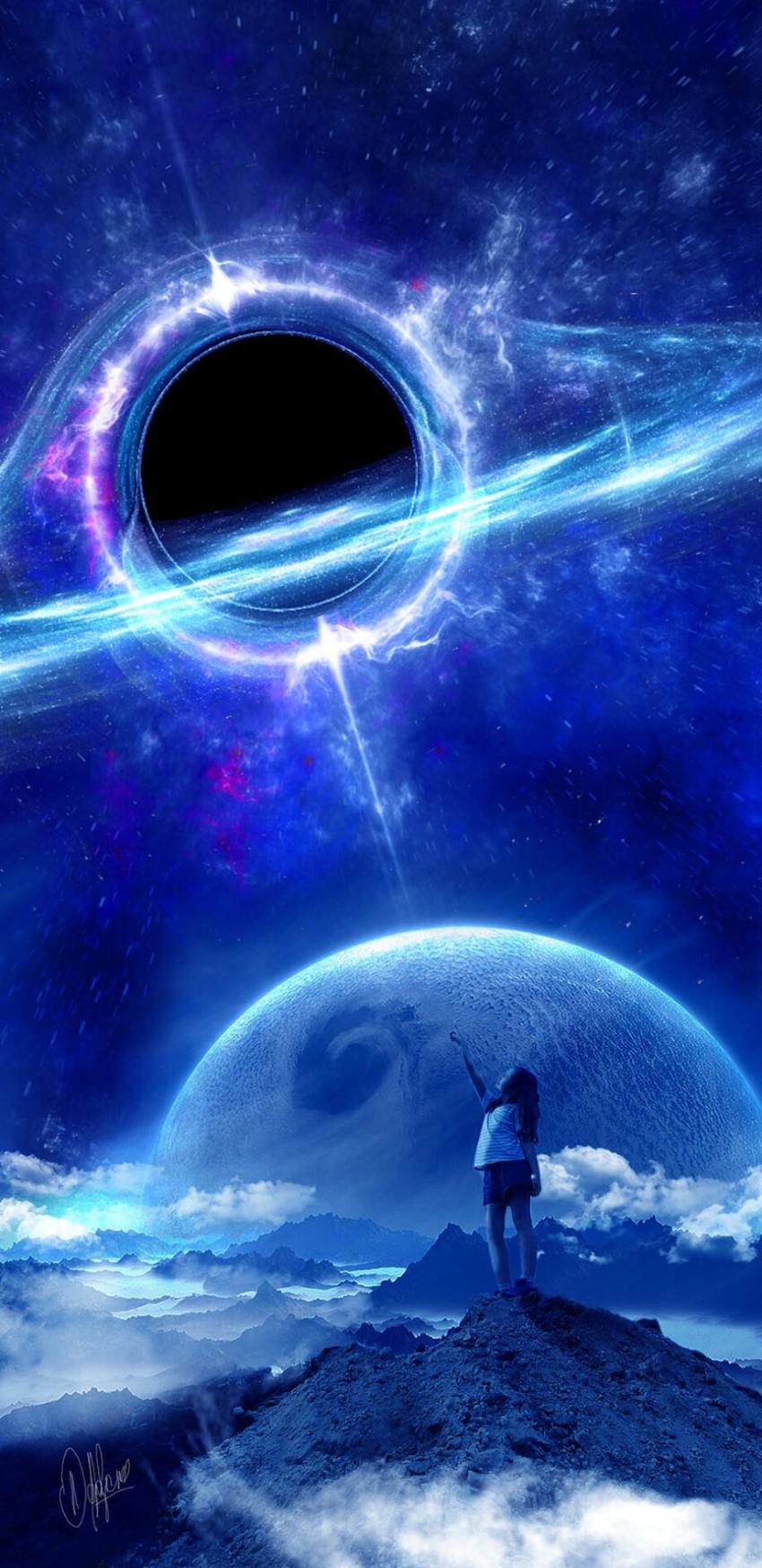
What is seen: A child figure standing on the peak of a rock, stretching an arm toward the sky. Simple clothing, natural gesture, a small body before the immensity.
The child is not a symbol of bravery—she is a symbol of perceptive purity. Adults fill the silence because the rational mind cannot tolerate the void: it associates it with loss, with error, with what it cannot control. The child does not have those layers. She does not need to understand in order to act—she follows what she feels with the same naturalness as touching the rain. That is intuition before learned fear contaminates it. Silence restores this capacity to consciousness: when the noise stops, what the body knows can be heard once more.
The Black Hole and its Accretion Disk — Silence with Edges of Light
What is seen: In the upper part of the image, an absolute circular void—total black—surrounded by a spinning ring of blue-white light. Trails of energy stream from the disk in various directions.
The black hole is radical silence: the place where light itself is absorbed, where nothing escapes, where known laws cease to function. But it is not just darkness. The accretion disk—the matter spinning before being absorbed—shines with the most intense light in the entire composition. That paradox is the heart of the card: the most luminous thing appears right on the edge of the darkest thing. Silence does not illuminate from its center—it illuminates from its border. That which transforms as it approaches the void shines brighter than that which stays far away.
The Planet — Immensity as Context
What is seen: In the background of the scene, an enormous celestial body—a moon or planet—in blue tones with visible surface texture. It looms behind the mountains as part of the cosmic landscape.
The planet is not in the way—it is the context. It is the scale of the world in which this child moves: a universe where the immense is normal. It does not block or mediate. It simply reminds us that what seems enormous from the human perspective is only a part of the landscape. The child pays no special attention to it—her intuition carries her higher, toward the void. The planet is what the adult eye would look at first. The child looks beyond.
The Mountain and the Rock — The Highest Point You Can Reach with Your Feet
What is seen: The child is on the peak of a rock in the foreground. Behind, a bluish mountain range with clouds between the peaks.
The mountain is the effort already made. What you climbed, what you worked through, what you learned to get here. The rock where she stands is the highest point you can reach with the body. After that, what remains is to stretch—an arm extending toward what the feet cannot reach. Silence begins where effort ends.
The Falling Particles — What Traverses the Silence
What is seen: Fine diagonal lines crossing the image, like rain, snow, or cosmic particles falling.
Silence is not an empty or clean space. Something always traverses it—a thought, a sensation, a memory. The particles remind us that inhabiting silence is not about stopping everything: it is about letting things pass without grasping them. The rain falls on the child and she does not seek shelter. She is there, getting wet, looking up.
The Blue Palette — The Coldness of the Vast
What is seen: The entire composition is in tones of deep blue, dark violet, and black. The rock where the child stands is the only warm element—brown, earthy.
Blue is not sadness here. It is vastness. It is the temperature of space when there is nothing to warm it. Silence is not warm. It does not console. It opens. The contrast with the warm rock says something important: the human, the earthly, the concrete is the only point of warmth amidst the vastness. The child carries her warmth with her—she does not look for it in the silence.