The Tree of Light
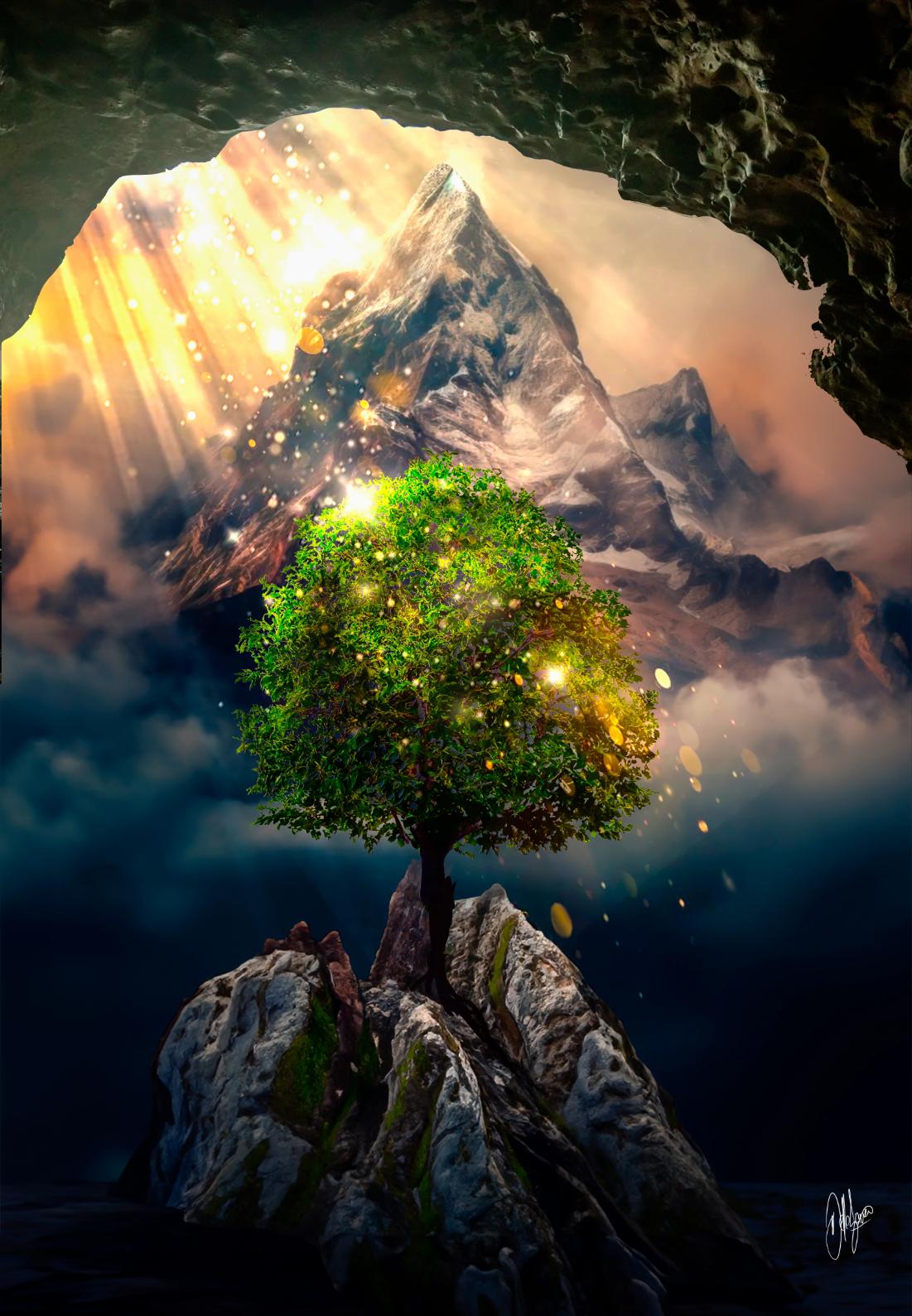
A radiant tree rises from the shadows of the cave, connecting the depths of the earth with the clarity of the sky. Alchemically, this tree evokes lignum vitae, the tree of life of the Great Work. In the alchemical tradition, it can only fully flourish within the vas hermeticum, the sealed vessel of transmutation. Here the cave itself acts as a sacred athanor, and the tree – nourished by mineral darkness – symbolizes the raw material that is refined to reveal spiritual gold. Its roots sunk into the rock represent the nigredo phase (work in black), when everything seems to disintegrate in the night of the soul. But from that dark matter life emerges: little by little, with patience, the internal “lead” is transmuted. The golden leaves of the tree suggest that the citrinite phase (the golden dawn) has been reached that precedes the final illumination, the rubedo, where the spirit blooms fully. In Hermeticism, the tree of light is the axis that unites microcosm and macrocosm, the living bridge between the terrestrial and the divine. Its roots drinking from the earth and its branches caressing the celestial vault reflect the ancient axiom of the Emerald Table: “as above, so below; as within, so without.” The growth of the tree from the center of the cave tells us about sacred correspondences: the inner awakening of the seeker (microcosm) harmonizes with the universal light (macrocosm). It is also an image of the axis mundi, the center of the internal world where one can receive guidance from above while being deep within oneself. From the Jungian perspective, the tree that sprouts in the cave embodies the process of individuation and the emerging Self. In dreams and myths, the tree usually represents psychic totality: it roots in the unconscious (earth) and expands towards consciousness (heaven). This luminous tree would be the manifestation of the Self – the divine core in the psyche – being born from the integration of the shadow. Each section of its trunk tells the story of an ascent from darkness to light, just like the soul that faces its traumas and denied aspects in order to grow. It is, in essence, the inner tree of each person: a living symbol that within us there is an innate capacity for regeneration and elevation, no matter how arid the land of our history has been. The Tree of Light reminds us that our deepest roots, even sunk in the night of the unconscious, can bear luminous fruit if we nourish them with honesty and love.
The Sacred Cave
The scene takes place inside a dark cavern that opens to the outside world. In alchemy, the cave is synonymous with the opus contra naturam: the secluded place where the miraculous transformation occurs. It is equivalent to the hermetic oven where the raw material (our raw psyche) is slowly cooked. The cave is both a womb and a tomb, a container for the alchemical nigredo – the primordial darkness necessary for something new to be born. The ancient alchemists knew that without the black stage of putrefaction, gold cannot emerge; So our soul also requires that retreat in the shadows to generate its light. Consciously remaining in the inner cave – in our moments of pain, uncertainty or “dark night” – is comparable to heating the athanor until the impurities dissolve. In Hermeticism, the cave symbolizes the inner sanctum, the perfect vas hermeticum because it is isolated from the outside world. It is the silence where the voice of the spirit resonates. The Hermetic sages taught that self-knowledge ( nosce te ipsum ) is the route to enlightenment: to descend into the cave of the heart is to reconnect with the divine spark that dwells within. This grotto also evokes the Platonic myth: abandoning the chains of illusion and entering the deep cavern to then be able to emerge into the light of the Sun of truth. In esoteric terms, the cave is the Hades or symbolic underworld to which the initiate descends to face trials and obtain wisdom. Within it, away from the “noise” of the world, the seeker faces his inner demons and discovers that the darkness is not empty, but pregnant with meaning. Psychologically (Jung), the cave represents the deep unconscious, that area where the Shadow and the hidden treasures of the psyche reside. Carl Jung compared the cave to an initiatory tomb: there the ancient identity dies and a broader consciousness is reborn. Jung said that “one does not become enlightened by imagining figures of light, but by making darkness conscious.” In this card, entering the cave is equivalent to daring to look at our wounds, fears and repressed parts. It is the necessary confrontation with the Shadow to begin individuation. The sacred cave invites us to remain in fertile discomfort: instead of fleeing from the darkness, honor it as the matrix of our authentic being. Just like the hero who enters the belly of the whale on his mythical journey, we in the inner cave find the test and also the blessing: embracing our darkness to transform it into conscious light.
The Primordial Rock
From the hard, dark rock emerge the roots of the tree of light. In alchemy, the rock can be seen as the prima materia, the raw, chaotic raw material from which the Philosopher's Stone originates. "The [philosopher's] stone comes from man, and you are its mineral; it is found in you and it is extracted from you," reads an alchemical text. That rock represents everything in us that seems rough, immovable or painful – our traumas, trials and earthier aspects – and yet contains the germ of enlightenment. The tree transmuted that hardness into sustenance: what hurt becomes gold. We are faced with the metaphor of transforming the lead of suffering into the gold of wisdom. From hermeticism, the rock symbolizes the basis of material reality, the solvé that must be undone to free the spirit. It is the fulcrum from which we rise: “the stone rejected by the builders becomes the cornerstone.” Here the cornerstone is our crucial wound or difficulty, which if accepted and worked on becomes the foundation of our rebirth. Hermeticism teaches that every obstacle contains its hidden lesson; Thus, the rock in the cave is both an obstacle and a support. The tree unites heaven and earth precisely thanks to the rock: it shows that our greatest challenges can become the exact platform from which to be reborn and ascend. That is, the hardest thing on our path can be what forces us to grow towards the light. In Jungian psychology, the primordial rock could be associated with the symbol of the Self in its unpolished aspect, or with what Jung called the “inner stone” that one must find within oneself. The rock is also our psychic foundations, sometimes rigid beliefs or early experiences that form us. Confronting that rock—recognizing what is fixed, fearful, or painful in us—is a vital step in the journey of individuation. Only by accepting “what is” (our basic reality, with its limits and wounds) can we put down real roots. Paradoxically, the solidity of the rock provides security: it gives us a place to affirm ourselves to begin the transformation. The inner tree needs to anchor its roots in the truth of our life, no matter how hard it may be, to grow authentically. The Primordial Rock teaches us resilience: our roots cling to even the most difficult experiences and, by integrating them, we find in them unexpected nutrients for our evolution. That which seemed like death (inert stone) thus becomes the foundation of new life.
The Golden Light
A golden glow emanates from the center of the tree, illuminating the cave and projecting outwards. Alchemically, this golden light is the symbol of philosophical gold, the culmination of the Great Work. After passing through the blackness of the nigredo and the purification of the albedo (whiteness), the moment of citrinitas arrives: the dawn of consciousness, represented by gold. Finally, rubedo is achieved when that inner light stabilizes in a new spiritual reality. In terms of the alchemical work, the golden light of the card is the illuminated soul that radiates after having integrated its shadow. It is not a light that comes from outside, it is lit from within – it is the secret fire born from contact with darkness. Alchemists would call it the internal lux, the liberated divine spark. In the Hermetic tradition, golden light is associated with the nous or divine intellect, the spark of universal Mind present in the human being. It is reminiscent of the original light of the spirit: that which in us is eternal and stellar. We could imagine that this light is like a small inner star awakening in the cave: an internal sun. The hermetists saw correspondences between the stars in the sky and the lights of the soul; “As the Sun shines above, a solar spark shines in the heart of man.” This golden luminescence is a sign of gnosis, of experiential knowledge of our divine nature. In the Corpus Hermeticum we speak of a second birth in light: the moment when the initiate recognizes the mental Light within himself and unites with it. Here, the lit tree would be the person who has awakened that mental light and radiates it in his or her life. From archetypal psychology, an inner light usually represents consciousness, wisdom or the manifested Self. Jung noted that the psyche tends to symbolize the whole through images of light (the radiant mandala, the gem, the sun). The golden light in the cave is analogous to internal illumination: it could be seen as the Self shining into the consciousness of the individual. It is the inner voice made visible clarity. After confronting the shadow, this golden light arrives with a deep sense of meaning and purpose. It represents the personal truth reached after the dark journey. It also embodies achieved individuation: the individual has “gilded” his being, integrating his opposites and finding a secure internal orientation. In Jungian terms, now the ego (the conscious person) follows the guidance of that light that comes from the center of the psyche, instead of depending on outside lights. The Golden Light reminds us that authentic guidance and knowledge comes from within: once lit, that flame of self-awareness is the beacon that dispels any darkness on our life path.
The Illuminated Mountain
In the distance, beyond the mouth of the cave, is a glimpse of a mountain bathed in golden rays. In alchemy, the mountain often symbolizes the completed opus, the spiritual elevation after transformation. Climbing the mountain is equivalent to reaching the rubedo, the culmination of the Work in red, where the transmuted being shines like the Sun. In ancient hermetic and alchemical writings, sacred mountains are mentioned where the truth is revealed (the Mons Philosophorum): the mountain in this image, kissed by the light of dawn, is the destination of the soul after its underground passage. It tells us about ascension: after putrefaction and regeneration in the cave, consciousness ascends to a higher plane, represented by the golden peak. Under the hermetic gaze, the illuminated mountain represents the macrocosm in harmony with the microcosm of the seeker. Just as the tree shines inside, the mountain shines outside; the internal and external are mirrored. We can see here an analogy with Plato's cave myth: after discovering the true light within himself (the illuminated tree), the individual can leave the cave and contemplate the rising Sun of spiritual reality. The golden mountain is that horizon of expanded consciousness. In hermetic terms, it also evokes the idea of return to divine origin: in many traditions the mountain connects the earth with the sky, it is the exterior axis mundi, a place of revelations (think of Mount Sinai, Olympus or the mystical Arunachala). That it is illuminated suggests that higher knowledge awaits the adept who completes his inner journey. From Jungian psychology and the hero's journey, the mountain at the end of the dark valley represents reintegration with the world after transformation. The hero leaves the cave with the “elixir” and must ascend again to the realm of everyday life, but he does so renewed. The light at the top symbolizes the new perspective, the gained wisdom that now illuminates your path in daily life. Jung could say that the mountain embodies the fullness of the Self towards which we are heading: it is the distant goal that guides our process of individuation. Each step on the slope is the integration of what was learned in the shadows. We could also interpret the mountain as the future challenges that we will face with the inner light already awakened. The card suggests that, thanks to having taken root in our darkness, we can now scale the heights of our personal fulfillment. The Illuminated Mountain blesses us with the vision of purpose: it tells us that there is a spiritual north—a summit of essence—toward which we are heading, and that all the transcended darkness has prepared us for that conscious ascension.