The Hooded Magician — The One Who Acts from the Center
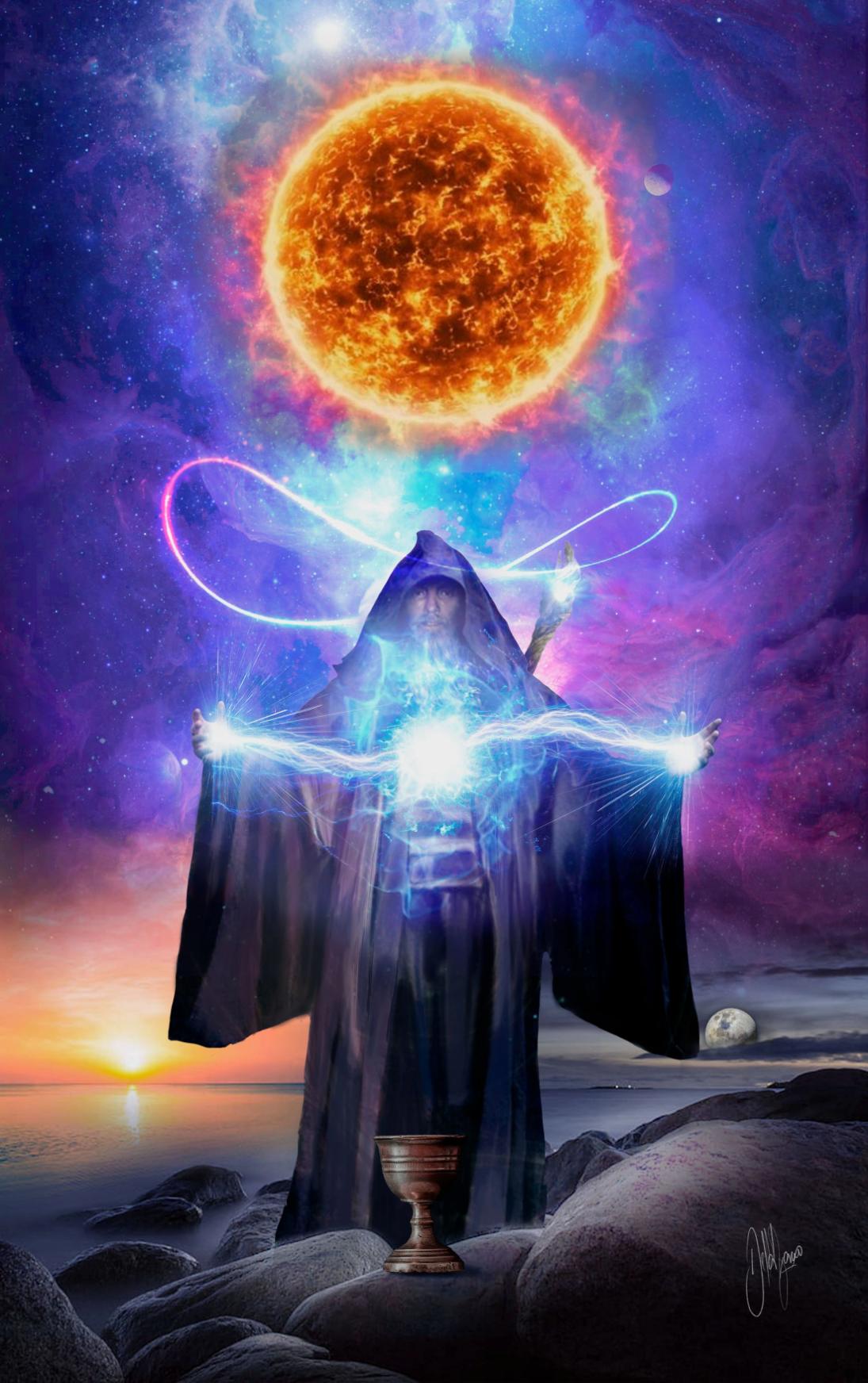
What is seen: an upright figure wearing a dark robe, a hood partially concealing the face, beard visible, arms extended with open palms. The hood does not hide — it protects. The magician does not need to expose himself in order to operate. His identity does not reside within the face, but within the act itself. The open arms are the oldest gesture of mediation between planes: he holds nothing, yet everything passes through him.
The Electric Energy — The Activated Essence
What is seen: streams of white-blue light emerging from the center of the chest and both hands, like electrical discharges connecting the three points. This is not decorative light. It is essence in motion — the exact moment when what is internal ceases to be potential and becomes visible force. It emerges from the chest (not the head, not the eyes) because the magician's center of operation is the heart, not the intellect.
The Sun — The Fire That Is Not Negotiated
What is seen: a massive burning sun with a crown of fire dominating the upper part of the image. It is not the magician's sun. It is the sun. The source existing with or without him. But the magician's position — directly beneath it, aligned with its center — reveals that he chose to stand within the axis of that fire. He did not create it. He aligned himself with it.
The Lemniscate — What Neither Begins nor Ends
What is seen: an infinity symbol traced in light above the figure's head, with magenta-pink tones on one side and white-blue tones on the other. The crossing point of the lemniscate aligns directly with the magician's head. That is not ornamentation — it is position. The magician exists exactly where the cycles intersect: where what rises becomes what descends, and what descends becomes what rises. The duality of color reinforces this: two distinct tones forming one continuous figure.
The Chalice — What Receives Without Demanding
What is seen: a dark metal chalice resting upon the rocks at the magician's feet. It is not held in his hands. The chalice is not grasped — it is offered. It remains below, upon the earth, open. It is the vessel where the waters gather: what heaven offers, matter receives. The fact that the magician does not hold it says something important: he does not need to control what he receives. He trusts that what descends will find its place.
Sun, Moon, and Cosmos — Dual Matter
What is seen: besides the central sun, at least one smaller celestial body (moon or planet) visible on the right side, a sunset along the left horizon, and a star-filled nebular sky. The magician does not operate within emptiness — he operates within duality. Sun and moon, fire and water, heaven and earth. The entire scene displays the opposing pairs constituting matter, while the magician stands between them — not choosing one side, but activating the entire circuit.