The Lighthouse
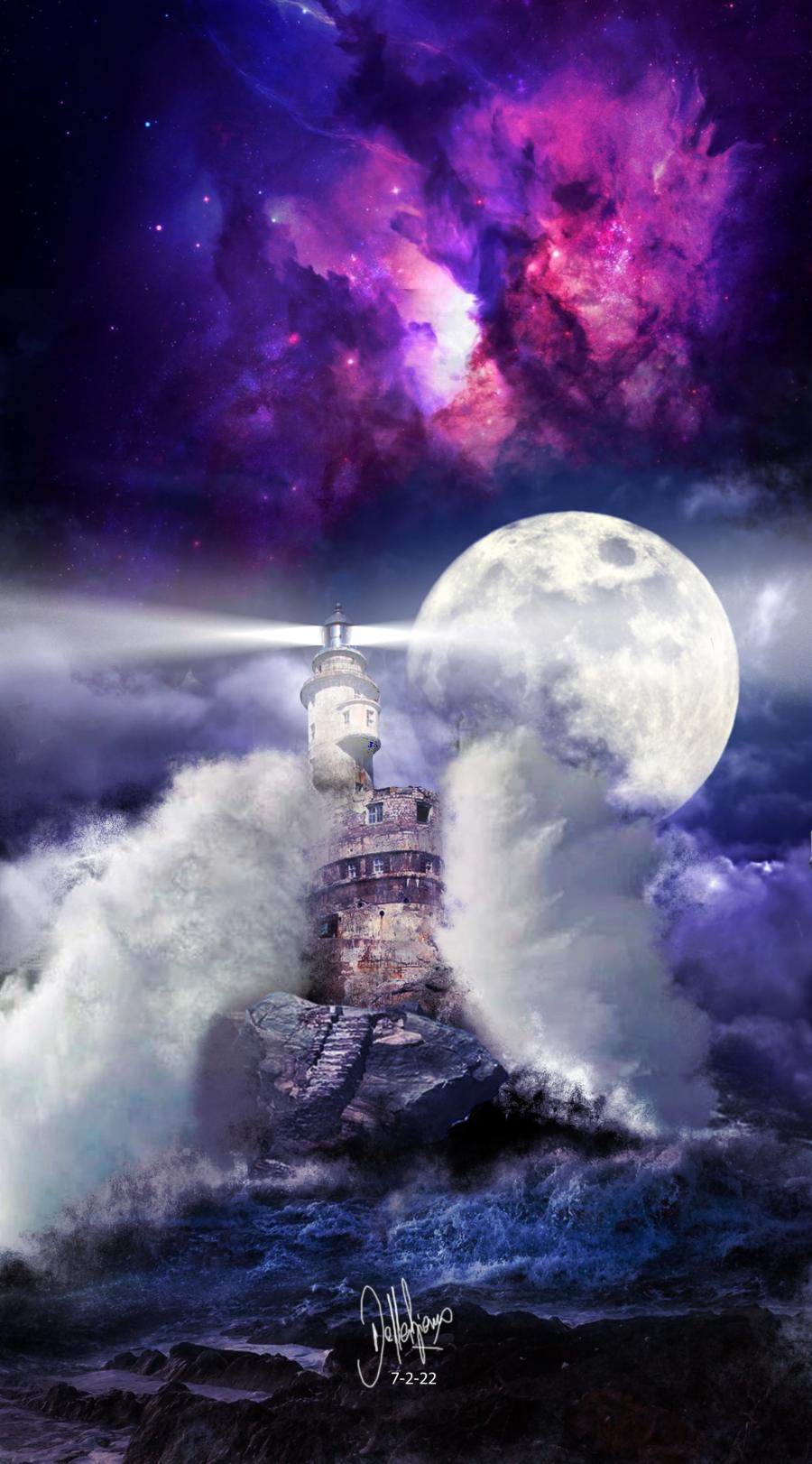
The lighthouse embodies the inner guide and awakened consciousness that rises above confusion. In Jungian terms, we can associate it with the archetype of the Wise Elder or the Self, that central part of the psyche that illuminates our life path with wisdom. Like the Hermit of tarot – an old man who carries a lantern at night – the lighthouse symbolizes the light of spiritual insight we gain in solitude and reflection. Hermetically, the lighthouse tower stands as an axis mundi, uniting the terrestrial (the rock and the sea) with the celestial (the moon and the starry sky). Its light acts as a bridge between above and below, reflecting the ancient axiom of the Emerald Tablet: “as above, so below.” Alchemically, we could see in that light the secret fire of the spirit, an internal solar spark that guides the opus of our transformation. It is worth remembering the words of the writer Mehmet M. Ildan: “To be a lighthouse, you must be strong enough to resist all storms and have a very powerful light within you.” Indeed, the lighthouse of the card reminds us of the strength and clarity that comes from cultivating our inner light: that patient strength that remains standing and illuminates even when everything around is stormy.
The Stormy Sea
Depth psychology sees in the sea a symbol of the collective unconscious – “the sea is the symbol of the collective unconscious, as it hides unfathomable depths beneath its surface,” Jung explained in Psychology and Alchemy –. In the card, the raging ocean represents those emotional and psychic contents that agitate our inner life when they burst into consciousness. The storm unleashed on the waters personifies the chaos of a crisis: the fury of passions, fears and internal conflicts swirling in the soul. From the Jungian perspective, going through this “psychic storm” is part of the process of individuation – the path of becoming who we really are by integrating our shadows.
Alchemically, the storm corresponds to the nigredo phase, the “black work” where everything decomposes into chaotic matter as the initial step of transmutation. In this dissolving (solve) of the old forms is the opportunity to reconfigure (coagulate) a new, purer and more conscious identity. Mythical traditions saw in the great waters a power of purification and rebirth: just as the flood cleanses the earth to make way for a new order, our own internal storms can purify the impurities of the soul, allowing clarity to emerge after the storm. Working with this rough sea requires courage, but it is precisely by facing the emotional waves that we refine our spirit. Hermetically, we could say that immersing ourselves in these turbulent waters is a baptism of the soul: a test that, if crossed with awareness, elevates our understanding and balances inner forces.
The Rock
The rock on which the lighthouse sits is a symbol of stability and roots. It represents the immovable center of the soul, that part of us that remains solid in the face of life's onslaught. In psychological terms, we can see it as our core values, our deep convictions, or the essential sense of identity that sustains us when everything else shakes. Jung could associate the rock with the firm foundation of the ego connected to the Self – the secure base from which illuminating consciousness can rise. Alchemically, rock alludes to the fixed substrate necessary for the Great Work: just as raw material must rest in a stable athanor, our psyche needs an anchor of reality and self-awareness to channel chaotic energy toward light. Hermetically, the stone evokes the element Earth, the principle of solidity and sustenance: it reminds us that spiritual enlightenment is not evasion, but embodying light in the concrete. Without a firm rock there would be no lighthouse standing; Likewise, without a solid core of self-love and self-knowledge, the inner light cannot remain constant. This rock invites us to cultivate that rootedness: to practice presence, self-care and fidelity to who we essentially are, so that no storm will knock us down.
The Full Moon
The full moon shines on the scene like a celestial lantern, a symbol of nocturnal illumination and the wisdom of the unconscious. In Jungian psychology, the moon often represents the inner feminine (the anima, or the receptive-intuitive aspect of the psyche), as well as the cyclical and emotional dimension of the mind. Its silver light is not its own but reflected from the Sun – similarly, the moon personifies how consciousness illuminates the contents of the unconscious: it is the intuitive truth that appears in our dreams, glimpses and inspirations during the darkness. A full moon indicates fullness and completion of a cycle; In the context of the letter, its presence suggests a moment of inner revelation in the midst of the night of the soul.
Alchemically, the Moon is the Queen (silver and mercurial principle) who must join the King (the golden and sulfuric Sun) to generate the Philosopher's Stone – that is, the transformed consciousness. Although the Sun does not appear directly in the image, its lunar counterpart reminds us of that sacred union of opposites: the light of the lighthouse (the inner Sun) and the light of the Moon (the illuminated unconscious) work in concert, realizing the alchemical coniunctio within us. In the Hermetic tradition, the moon also symbolizes the soul reflecting divine light: it teaches us the importance of reflection and receptivity to obtain clarity. Under the full moon, the external and internal tides intensify; Similarly, the card indicates that our emotions rise to the surface to become conscious. The Moon invites us to honor our emotional cycles and trust intuition: even in complete darkness, it provides a subtle light that guides our steps.
The Purple Starry Sky
The starry purple sky that expands over the scene intensifies its mystical and transcendent atmosphere. The color purple, the result of mixing blue (the celestial, the mental) with red (the earthly, the passionate), is traditionally a symbol of spiritual transmutation and connection with the divine. In alchemy, purple can be associated with the intermediate state that announces inner illumination (similar to the citrinite phase, the golden dawn that precedes rubedo). It suggests that we are at a threshold between the dark night and the emergence of a new light. From Hermeticism, this star firmament reminds us of the correspondence between the macrocosm and the microcosm: just as the constellations trace an order in the night sky, our soul contains its own firmament of archetypes and possibilities. “What is above is below,” says the Hermetic Law, teaching us that our internal process resonates with the cosmic order.
Contemplating a sky full of stars evokes guidance from above and the feeling that we are not alone in our nights: each star can be seen as a hope or an insight that flashes into consciousness. In archetypal psychology, a cosmic sky indicates the expansion of perspective beyond the individual ego, the opening of the mind to a greater reality. Purple in particular is the color of internal metamorphosis and spiritual coronation (not for nothing is it associated with the crown chakra, the door to transcendence). Thus, the starry purple sky of the card envelops us in a promise: after the emotional storm, the soul aligns with a higher purpose, finding meaning and direction in the midst of the vastness. This cosmic firmament inspires us to lift our inner gaze toward our own north star: that truth or personal mission that guides us even in the darkness.