The Black Chess King — The Identity That No Longer Governs
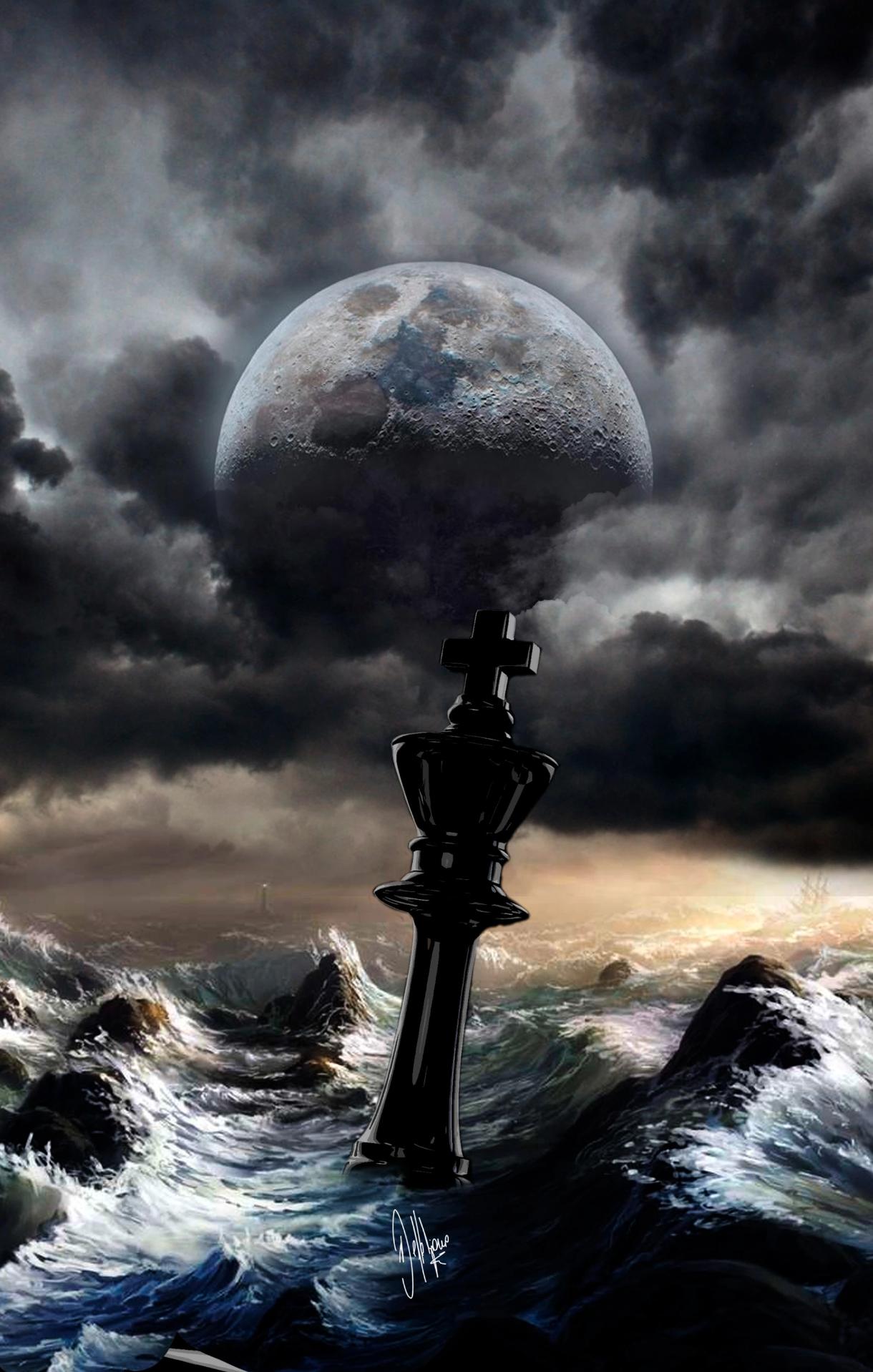
What is seen: A black, shiny chess king piece, standing upright in the center of the image. Water surrounds it halfway up. The cross on the crown stands out against the sky.
It is a game piece. Not a living king—a representation of a king. This matters: what is drowning is not the person but the role, the structure, the idea of sovereignty based on control. The reflective black turns it into a mirror: it returns what it receives. And the cross on top marks the verticality that still sustains—but a cross is also a weight.
The Stormy Sea — That Which Is Not Governed
What is seen: Dark, agitated waves with white foam. Aggressive movement in all directions. Rocks peaking through the water.
The sea does not attack the king. It is not personal. It simply does what it does: it moves without asking permission. What the water represents is not an enemy, but a force that does not respond to command. Everything the king knew how to govern—logic, strategy, position—has no effect on the tides. The drowning begins when something that always worked ceases to work.
The Full Moon — That Which Sees Without Intervening
What is seen: An enormous, detailed, silver moon, partially covered by storm clouds. It occupies a large part of the sky behind the king.
The moon neither rescues nor condemns. It illuminates what is there, just as it is. Its scale in relation to the king is overwhelming—it is immensely larger. This situates the scene: what to the king is a total crisis, to the moon is just another moment. That does not minimize the pain. It frames it.
The Rocks — That Which Does Not Dissolve
What is seen: Dark rock formations among the waves, solid, motionless. While the water moves and the king drowns, the rocks remain.
They are not a refuge—they are evidence that something resists the storm without trying to resist. They do not fight the waves. They were there before the water, and they will be there after.
The Distant Light — What Remains When Everything Fades Out
What is seen: A warm, faint point of light on the left horizon. Barely visible.
It is not a glorious lighthouse. It is a minimal presence that can be distinguished only because everything around it is dark. It does not promise rescue. It does not point a direction with certainty. But it exists. And in a composition where everything is gray and black, that warm point is enough for the gaze to have somewhere to go when it lets go of the king.